Social Procurement: An Update, a Reframe, and a Quiet Source of Business Advantage
“Social procurement isn’t about doing good instead of doing business. It’s about doing business with a fuller understanding of risk, value, and people.”
Social Procurement: An Update, a Reframe, and a Quiet Source of Business Advantage
At Beaumont Procurement, we spend much of our time helping organisations make sense of ideas that sound compelling at a system level but feel less clear when they land on a procurement desk on a Tuesday morning.
Social procurement is one of those ideas.
It is being talked about more frequently, more confidently, and in more senior forums than even a few years ago. That alone is worth paying attention to. But attention is not the same as understanding, and understanding is not the same as execution.
This article is intended as three things.
An update on how social procurement is currently being framed at a global level.
A reframing of what it actually means for procurement decision making.
And a clear answer to the question procurement leaders always ask, sometimes quietly, sometimes out loud.
So what?
A brief update on where social procurement sits today
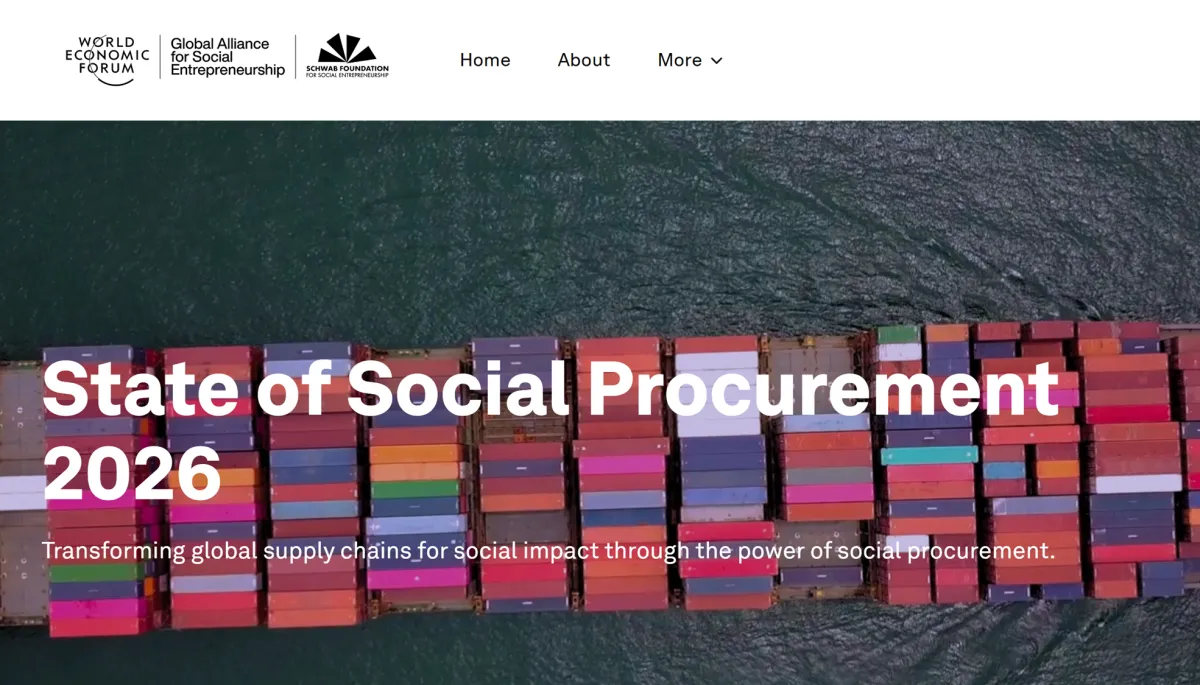
Much of the recent momentum around social procurement has been shaped by work convened through the World Economic Forum and its Global Alliance for Social Entrepreneurship. The ambition is clear. Procurement spend is not just an operational necessity, it is a powerful economic lever. Used intentionally, it can support inclusive employment, strengthen local economies, and create more resilient supply chains.
Organisations such as Telos have contributed to this work, helping to articulate how social enterprises and inclusive suppliers can participate more meaningfully in mainstream markets rather than sitting at the margins.
At this level, the narrative is necessarily broad. It sets direction, language, and aspiration. That is important work. But it is only the starting point.
Because once this thinking moves from policy papers into sourcing strategies, procurement professionals have to reconcile it with commercial reality.
That is where the real work begins.
Why the conversation is changing, especially now
It is worth acknowledging the wider context.
In recent years, social and sustainability agendas have enjoyed strong political tailwinds in many parts of the world. That is no longer uniformly the case. In the United States in particular, the tone has shifted. There is greater scepticism around ESG language, more scrutiny of what is perceived as overreach, and a renewed emphasis on economic competitiveness and domestic resilience.
For procurement leaders, this matters.
It means that social procurement cannot rely on moral arguments alone. It has to stand up as a business proposition. It has to be defensible in front of finance, executives, and boards who are increasingly asking harder questions about cost, risk, and return.
In many ways, this shift is healthy. It forces clarity.
Retiring the first misconception: social procurement as a cost premium
One of the most persistent myths is that social procurement is, by definition, more expensive. That it is something organisations do despite commercial logic, not because of it.
In practice, that framing is too simplistic.
Social procurement often changes where cost shows up, rather than whether cost exists at all. Unit prices may be higher in some cases. But total system cost often looks very different once you factor in supply disruption, labour instability, compliance failures, and reputational damage.
Procurement professionals understand this instinctively. They have lived through supplier failures that wiped out years of negotiated savings in a single quarter. They have seen how fragile supply chains become when labour conditions are ignored until they become a problem.
Social procurement, approached properly, is often less about spending more and more about avoiding expensive failure.
That distinction matters.
Risk, resilience, and the economics of steadiness
There is another dimension that deserves more attention. Stability.
Suppliers that invest in fair work, inclusive employment, and community engagement often exhibit characteristics procurement teams value highly. Lower labour churn. Greater operational continuity. Stronger licence to operate in the communities where they work.
These qualities rarely show up cleanly in a spreadsheet. But their absence is painfully visible when things go wrong.
Seen through this lens, social procurement is not a values-led add-on. It is a risk management tool. It compresses risk. It reduces volatility. It increases resilience.
Most organisations only recognise this after a disruption. The more mature ones learn to price it in beforehand.
Expanding the supplier landscape, not narrowing it
Another assumption worth challenging is that social procurement restricts choice.
In reality, it often expands it.
Social enterprises and inclusive suppliers frequently operate in markets, geographies, or labour pools that traditional suppliers struggle to reach or choose not to prioritise. In constrained categories, this can increase optionality rather than reduce it.
The commercial question is not whether organisations should buy from social enterprises in principle. It is where, and under what conditions, these suppliers create strategic advantage within the wider supply base.
That is a procurement conversation, not a philosophical one.
The human dimension: talent, credibility, and why people choose to stay
There is also a quieter benefit that is becoming harder to ignore. Talent.
Just as sustainability has become a factor in where people choose to work, social procurement is beginning to play a similar role. Many professionals want to work for organisations that can explain not just what they buy, but how they buy and why those choices make sense.
This is not about slogans or corporate statements. It is about credibility. People are increasingly adept at spotting the difference between performative commitments and thoughtful, well-executed practice.
Organisations that can demonstrate this tend to find it easier to attract, motivate, and retain capable people, including in procurement itself. In a tight labour market, that is not a soft benefit. It is a competitive one.
Where organisations really get stuck
In our experience, the biggest barrier to social procurement is not intent. It is capability.
Most procurement teams have not been trained to evaluate social value claims with the same rigour as financial ones. They struggle to make trade-offs explicit between cost, risk, service, and impact. They are often uncomfortable defending these decisions in front of finance or executive stakeholders.
As a result, social procurement remains trapped at policy level. Well intentioned. Earnest. And fragile under pressure.
This is why social procurement should be treated as a decision discipline, not a compliance exercise.
So what does this mean in practice?
For procurement leaders and for students preparing to step into these roles, the implications are quite practical.
Social procurement needs to be integrated into how sourcing decisions are made, not bolted on afterwards. Trade-offs need to be visible, not hidden. Capability needs to be built deliberately, not assumed.
This is also why, in the Academy, we teach social procurement through real cases and real constraints. Not as a standalone ESG topic, but as part of what good procurement leadership looks like when the answers are not obvious.
A final reflection
Procurement is never neutral. Every decision shapes markets, incentives, and outcomes, whether we acknowledge it or not.
Social procurement does not ask procurement professionals to abandon commercial logic. It asks them to apply it more fully.
In a world of political shifts, economic pressure, and rising expectations, that may turn out to be one of the most quietly powerful sources of business advantage available.
And it is work worth doing.

What to do next
If this way of thinking resonates, take it as a signal.
Social procurement, like sustainability before it, is moving from principle to practice. The organisations that benefit most will be the ones that build capability early, before it becomes a compliance exercise or a crisis response.
At Beaumont Procurement, this is exactly the kind of work we focus on. Not slogans. Not policies for the sake of it. But helping procurement professionals make better decisions when the trade-offs are real and the answers are not obvious.
If you would like to:
explore how social procurement fits into commercial decision making
build confidence in balancing cost, risk, service, and impact
or simply stay close to this kind of thinking as it evolves
Richard Beaumont
Founder
